Laocoön... Laocoön...
Kamal Abdulla
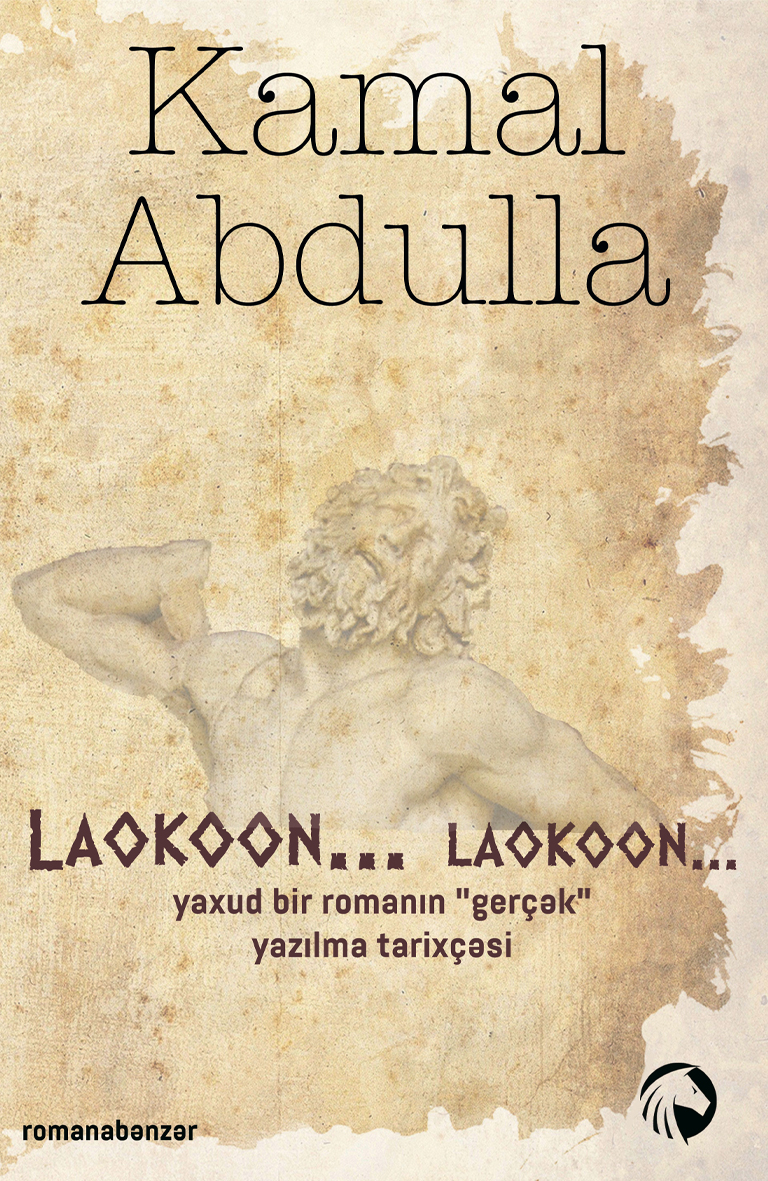
I read People's Writer, Academician Kamal Abdulla's Laokoon... Laokoon... and liked it so much—so much—that I decided to “praise” the academician.
Let's “cut the plough in the furrow and not get lost on the threshing floor” [Translator's note: Azerbaijani idiom meaning “let's be brief and to the point”]: Kamal Abdulla is a great writer who has made phenomenal contributions to Azerbaijani literature, theater, and, more broadly, the arts; he has written valuable works that have been discussed on an international scale; and he stands out for his style and approach. No one can object to that. However, I am not writing about the academician's entire oeuvre—nor do I intend to. I simply want to share with you the feelings I experienced as I read Laokoon... Laokoon... and found myself “astonished,” “amazed.”
The author's old friend, People's Poet Ramiz Rovshan, is the author of one of the panegyrics gathered under the heading “Foreword,” and there he notes that the core of this novel is the love story of two people—Vagif and Firangiz—with a large age gap between them. The book says nothing explicit about the characters' ages, but I wondered how my beloved poet inferred this “large age gap” and tried to calculate the ages from the clues the novel provides. We're told that Firangiz is a doctor who does not work. As a doctor myself, I know that one can obtain this qualification at the earliest around twenty-five or twenty-six. Considering that Firangiz did not graduate “on the very day” the novel was written and that she has been “idling about” without working for a few years, one may conclude that she is close to thirty. “Vagif muellim's” [Translator's note: respectful “Teacher/Professor Vagif”] age is not given either, but on page 55 of the edition I read (Köhlən Publishing House, 2021, first edition) we are told that our protagonist Vagif has a “thirty-year” friend, Aslan, with whom he “studied eleven years at school, in the same class.” From this we can calculate the ages of Vagif and Aslan: we start school at six, and they have known each other for thirty years; therefore Vagif is approximately thirty-six. It turns out the age difference with his beloved Firangiz isn't that big after all.
On the portion of that essay reproduced on the back cover, the People's Poet writes: “This new novel by my old friend Kamal (or, in his own words, his 'quasi-novel') is, I think, roughly the final, concluding book in the series of novels that began some twenty years ago with the famous The Incomplete Manuscript.” To be honest, this sentence struck me more as the poet's wish than his assertion.
The novel's main character is a professor and a writer holding office. Moreover, all the people he employs are half-witted and unscrupulous. I don't know why... In general, there is hardly anyone in the novel who thinks normally, reasons clearly, whose every behavior is praised and justified—except one person: Vagif. His brother is depicted, in the author's words, as “a somewhat odd fellow,” a drifter who can barely contain his joy at the prospect of driving Vagif's car; his subordinates are dishonest fools; his lover Firangiz doesn't know Dede Korkut and, as we read on page 86, “Until now she had read no one but Lermontov and Chingiz Abdullayev” (and yet, somehow, she is a doctor)... Vagif and Firangiz have a very interesting relationship in the novel: they meet to drink tea by the sea, then go to a dacha and spend the night there—they sleep together, they make love. And yet both are single... They don't marry... They are postmodern...
The novel's essential point is this: the author praises his character on page 29 as “Vagif, who understands and comprehends everything so well,” and this character makes his lover Firangiz read the epic Book of Dede Korkut and tries to write a novel about it—while the title is not given outright, we understand it refers to The Incomplete Manuscript. Firangiz, meanwhile, is presented as if she is hearing about the Book for the very first time. Frankly, perhaps because I could not fully grasp the author's extraordinary imagination, I could not understand how the girl was reading in the sentence on page 86: “From that point on, Firangiz lay on the sofa in her own room, reading the book pressed tight-tight to her chest with both hands.” First of all, a book is not pressed “tight-tight to the chest,” but rather pressed tightly to the chest [Translator's note: the adverbial placement in Azerbaijani suggests the sentence unintentionally describes a “tight chest,” not the manner of pressing]; be that as it may, how does one read a book that is pressed tightly to one's chest? Are the girl's eyes in her chest, or does hugging the book in sleep somehow transmit its contents into her brain? I did not understand... What astonished me most is Dr. Firangiz's complete ignorance of Dede Korkut. Is the academician, perhaps, hinting that doctors don't read?
The text has been “magnificently” copy-edited. One needs real “guts,” as they say, to count all the grammatical errors from beginning to end; after I counted sixty-four grammatical errors in the first thirty pages, I collapsed. For an academician—only sixty-four mistakes in thirty pages... One could “overlook” that. As for commas, it's not even worth talking about: it's as if, once the text was written, a whole bowl of commas was handed to the proofreader—“place these where needed”—and, dazzled by the “depth” of the novel, the proofreader lost composure, the bowl slipped, and the commas scattered across the page at random; wherever they fell, they stayed. On close inspection, you see that the commas in this text pay no heed whatsoever to the fact that the author is a People's Writer and an academician; nor do the rules of our grammar care a whit about the comma—wherever it has wanted to stand, there it has stood. Perhaps the commas, in this “lawlessness,” are a sign of the academician's boundless literary talent. Undoubtedly, this “brilliant” talent shines a bright light on the road for novices like me.
Postmodernism spurts from every seam of the novel. I write this deliberately in honor of the dictionaries the author repeatedly invokes in the text as “the endless lexicon of the familiar and the alien,” which he “successfully” uses while writing his novel. Yes, the author is so postmodern that he ignores the fact that in our language alışqan means a lighter (a tool used to ignite something), and alışqanlıq denotes flammability; instead of choosing the words öyrəşmək (“to get used to”) and öyrəncəli (“habitual”) that trip over his feet in that “endless lexicon,” he uses alışqan everywhere in the sense of “accustomed.” [Translator's note: Azerbaijani alışqan = “lighter”; author repurposes it as if “accustomed,” creating a jarring homonym.] In addition, the academician seems eager to give a special, one might say subliminal, contribution to Turkish–Azerbaijani brotherhood. Expressions such as “ən azından” (at least), “kuzen” (cousin), “laübali” (blasé), “cami” (mosque), “tanır-tanımaz” (barely knowing), “suç üstü yaxalamaq” (to catch red-handed), “dərsə gec qalmaq” (be late to class), “mışıl-mışıl yatmaq” (sleep soundly) are, as they say, a dime a dozen. Add to this predicatives without copular suffixes (“bunu danmaq imkansız”—“to deny this [is] impossible”) and incorrectly formed copulas (“deyilmiydi”—should be “deyildimi” [Translator's note: forms of “wasn't it”]), and one may say the academician is taking a strategic step toward the future, wishing to strengthen bridges between these two almost identical languages. Naturally, the academician does not forget our other neighbors either, and fills the text with nonstandard borrowings such as kurtka (jacket), papka (folder), tokdan çıxarmaq (to unplug), aeroport, podnos (tray), motor, balkon, paraliç (paralysis). When he consults the “endless lexicon of the familiar and the alien,” he does not waste time pondering words that might enrich our language and feel more native. The waiter at the “Shebeke” restaurant never actually serves dishes, yet he is sometimes xörəkpaylayan (“dish-dispenser”), sometimes çayçı (“tea-server”). Journalists are sometimes intervügötürən (“interview-taker”), sometimes qəzetçi (“newspaperman”). The word “Allah” also behaves like a deity in the text—capitalized when it wishes, lowercased when it pleases. Speaking of Allah, on page 141 the author writes: “That very night the man passed to mercy” [Translator's note: literal of “rəhmətə getdi,” a euphemism for “died”]. The man in question is the protagonist Vagif's father. I cannot understand why the author says “passed to mercy” instead of “died,” or at most “passed away.” Does he begrudge the protagonist's father his death, or what?.. ...and all this, of course, is in the author's narration, not in the dialogues.
Speaking of dialogues, the academician's exemplary postmodernism shows there too. The author of the book and the characters speak in exactly the same tone and register, and words used within a certain (narrow) range are misused in exactly the same way: the author says narahatçılıq instead of narahatlıq (“anxiety”), and so do the characters; the author says nigarançılıq instead of nigaranlıq (“worry”), and so do the characters; the author says yorğunçuluq instead of yorğunluq (“fatigue”), and so do the characters; the author says intervü instead of müsahibə (“interview”), and so do the characters, etc. This is, no doubt, a didactic literary “innovation” from which lessons are to be drawn.
The novel uses vanna otağı (“bathroom”) instead of hamam (“bath/hamam”). We are people who boast of having taught Europeans how to bathe—we say “the hamam is ours; the bath went to Europe from us.” On top of that, to use vanna otağı, the literal calque of the French salle de bain, instead of hamam seems to me the author's attempt to put an end to the banal chatter of “the hamam is ours.” “Excellent” job. There are sentences in the bath scenes that I truly did not grasp: “...with a fake sprightliness, in his alt tuman-köynək, flailing his arms and legs, he went into the bathroom,” or “Vagif, in his alt tuman köynək [Translator's note: earlier written with a hyphen, here separated; the reviewer jokes this might indicate the underwear slipped lower and separated from the shirt], slipped out of the bathroom.” I did not understand the word alt (“under”) in these sentences. I don't know—was there an üst tuman (“over-underpants”) he could have worn on top? Superman?..
When the academician's character—Vagif—analyzes Book of Dede Korkut, he draws conclusions even from things not written there; this is done very well, truly! From the things not written in the academician's Laokoon... Laokoon..., I too concluded that he does not use the metro; if he did, he would know that İçərişəhər (“Inner City,” the Baku station) is written as one word.
In some places the academician offers very “modern,” never-before-“seen” postmodern descriptions. For example, the last paragraph on page 125 reads: “Just as even the most depraved clocks show the correct time once a day, Vagif and Firangiz, for the first time today, understood each other properly.” (Translator's note: Azerbaijani “pozulmuş” means “morally depraved”). To be honest, I don't know what a “depraved clock” is supposed to be. At first I thought the author meant a broken, stopped clock, but then I realized I was wrong, because a stopped clock shows the correct time not once, as stated here, but twice a day. Presumably he means a clock so depraved it shows the correct time only once a day. In any case, these sentences bear no resemblance to the everywhere-copied truck-back maxim our Turkish brothers call kamyon arkası yazısı: “Even broken clocks show the truth twice a day.” [Translator's note: Common Turkish saying.]
There is also this sentence on page 86: “He was always astonished at how slowly the seconds and minutes passed. Days and months were fast, but seconds and minutes came slowly and turned into hours.” These lines, in a book published in 2021, did “not” in the least remind me of Teoman's 2000 song “Paramparça” (“Shattered”):
“...Nasıl oluyor, vakit bir türlü geçmezken
Yıllar, hayatlar geçiyor...” (“...How is it that, while time refuses to pass, Years, whole lives go by...”)
Between us, who do you think expressed this idea better—the People's Writer Kamal Abdulla, or the singer Teoman?
I can feel—indeed, almost hear—you say, “So you read that whole book and all you noticed were dots and commas.” I understand; you're right. But there is virtually nothing to discuss in the novel. A very simple plot line; a few office scenes unrelated to the novel's womb; praise of Vagif, repeated assertions of how helpful, intellectual, smart, worldly, cultured, farsighted he is, and, relative to him, how far behind everyone else falls in all these respects; plus dialogue overburdened with words and weakly written. There's a famous joke about such things: “...Not a girl, a boy; not Azrael, Gabriel; not a goat, a ram... How am I supposed to fix this?”
You might think, “This book is a continuation of The Incomplete Manuscript; that's why you didn't understand it,” but that is irrelevant. Laokoon... Laokoon... is a standalone book, sold for eight manats, published by Köhlən Press. It should have had its own independent subject and, more importantly, its own literary question. Speaking of printing, the production aspects are excellent. In terms of quality and design, I can say Köhlən has done a great job... In fact, these excellent things—the technical aspects of the book—belong to the printer, not the publisher. It seemed to me that Köhlən did not intervene in the text at all...
I would be remiss not to say this: in the work, the synthesis of motifs from Book of Dede Korkut with events set in the present day is handled at a very high level. Moreover, even if the author's character is not explicitly written in the Book, he tries to find girls who might love Basat from other signs, and he attempts to understand the jealousy that “might be experienced” between Banu Chichek and the Infidel's Daughter. He carries out discussions about the connections and similarities between the “spy,” said to have been present in the Oghuz lands but not explicitly named in the Book, and the priest Laocoön who opposed the Trojan Horse entering the city, and so on. These parts are so distinctive and beautiful that you truly take pleasure in reading them, and you regret the presence of the rest of the text. “If only good editing had cut the unnecessary parts,” I thought. Unfortunately, such tasteful, delightful sections are very few.
At the end, I have a request of those who read this piece: convey my words to the academician—let him know that his novel is not being copy-edited or edited. If this is by his own wish, if he does not allow anyone to touch his text, then let the book list his own name as editor and proofreader. Otherwise, we end up pinning all these problems on Djavid Zeynalli and Guler Ughur. Why should I consider Djavid Zeynalli a weak editor and Guler Ughur an inept proofreader for a book over which they had no influence? If they are not permitted to intervene in the text, then all responsibility remains with the author. With editorial intervention, at the very least, one could have written “at ten o'clock” instead of “at 10,” and narahatlıq instead of narahatçılıq (“anxiety”)...
One thing is clear: if a reader is greeted by sixty-four grammatical errors in the first thirty pages, then it is certain the text has not been properly worked on, cared for, corrected, or re-read; in a word, the text has been published and put on sale in a raw, “undercooked” state. That is an insult to the reader.
As for me—I merely “praised” the academician.