Shukriyya My Destiny
Ulviya Tahir
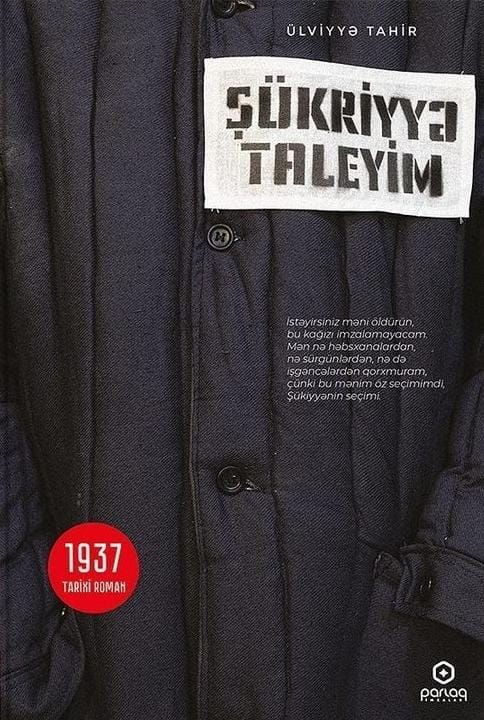
How many farewells does a person live through in a lifetime? One parts with childhood, with youth, with health, with patience, with hopes — but among them all, the hardest, I think, is to part with the people one loves. You may separate from them physically, yet your heart never truly says goodbye…
I can say with full confidence that this novel will take its rightful place in Azerbaijani literature. It is a profoundly moving work — one we can already consider a future classic.
The book begins with a letter arriving for a woman named Anaxanım, the mother whom Ahmad Javad's son Yılmaz addresses tenderly as “ay maa” (untranslatable; translator's note). The letter shakes her to the core. Only near the end do we discover who sent it and why it affects her so deeply. That the novel opens with a letter, with a message, is no coincidence. The entire book itself is a message — that Ahmad Javad did not die, that men like him cannot be killed. Ulviya Tahir conveys this message with remarkable subtlety. None of the ideas in the text feel didactic or forced; nothing hangs unresolved. Every theme the author touches is seamlessly woven into the texture of the prose, with extraordinary finesse. Without ever stating it bluntly, she also makes clear another truth: evil cannot triumph, for sooner or later, it ensnares those who serve it.
Some readers may find the language austere, but it must be remembered that the story takes place during the years of repression — in exile, amid the ruined hopes of a man like Ahmad Javad. Such a subject could never be told in ornate or sentimental prose. In this novel, Ulviya Tahir dispenses with all decoration, guiding the reader instead into the deeper layers of her text, directing our attention to the life of our great poet, to his family, and to the injustices they endured.
The narration alternates between the author's voice and that of Shukriyya herself. This choice is, I believe, masterful. It allows us to see Shukriyya's fate as closely as possible — to feel it from within. Ulviya Tahir has so fully inhabited her character, so intimately understood her suffering, that the boundary between author and heroine seems to vanish. The passages written in the first person read as if they were excerpts from Shukriyya's own diary. This immediacy draws the reader entirely into the narrative — you suffer with her, ache with her, rejoice with her.
Almost every major figure from the years of repression appears here, either by name or voice, and the novel succeeds brilliantly in recreating the spirit and atmosphere of that era. When I finished it, I had the uncanny feeling that this book had always existed — as if Ulviya Tahir had traveled back in time, taken pen and paper in hand, and simply recorded what she saw. That it was written in 2020 is hard to believe. Yet it is not a history book: every event bears the touch of a true storyteller.
The novel is nearly flawless. There are minor technical slips, but the work's power renders them invisible. I trust they will be corrected in later editions. I would perhaps have liked the dialogue to feel more fully anchored in the period — at times the characters speak with a modern cadence — but this is hardly a fault. Tahir is writing for the contemporary reader, and perhaps such accessibility is what allows today's audience to feel these lives so vividly.
In closing, I want to express my deep gratitude to Ulviya Tahir for this exceptional novel and the care she has devoted to it. I wish her continued success.
I loved this book — truly — and recommend it wholeheartedly to every lover of literature.