The Song of the Fire People
Fuad Isayev
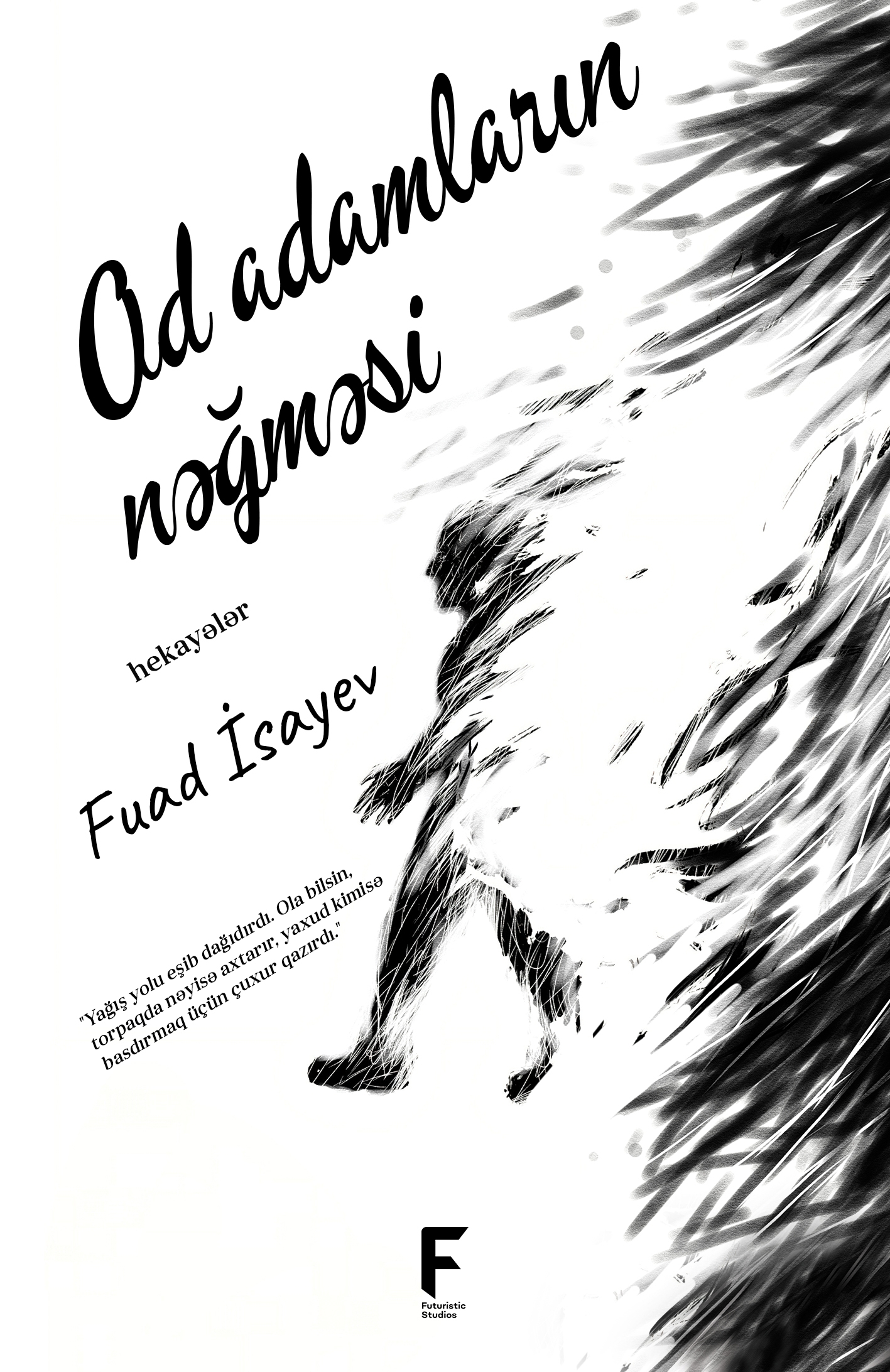
It would be more accurate to call this book a set of attempts rather than a short-story collection. It seems to me that Fuad Isayev wrote pieces to test a few genres, styles, and forms, then issued them as a book. Speaking of issuing: the volume is a product of a house called “Futuristik Studios,” yet in physical quality it is anything but futuristic—in fact it looks like something printed in the 1990s. The letters are dull, the errors many, the graphics weak. For all that, Isayev’s stories aren’t all that bad; more than once I found myself smiling as I read, and I nearly liked a few of them.
Jokes aside, despite its slimness and poor production, The Song of the Fire People is an interesting book—full of striking ideas, alternate worlds, and humans already sliding toward robotization. If only the stories had been properly edited before publication. There are many sentences left half-formed, too frail to carry what they’re meant to convey.
The book greets us with this off-putting line: “All the stories collected here are intended for mature readers.” What does that even mean—are there stories intended for immature readers? Is the author suggesting, for instance, that so-and-so writes for the simple-minded, while his are for the mature? My sense is that Fuad Isayev is trying to insure himself: if a story doesn’t please you, blame yourself—you must not be “mature.” That won’t do, dear author. Do you know whom the Azerbaijani reader reads, and in how many languages?
If the author had set an age threshold—“This book is for adults”—that would be different; I’d assume there was some gratuitous slang and let it pass. But here it’s not about age at all. It says “mature readers,” which is not the sort of warning that befits an author’s decorum.
The dialogue is weak in substance, and at times sprawls into a kind of empty chatter. Take a passage from “The Quietest Planet” (I copy exactly, grammatical errors and all):
“…” “Yes, everyone hears one another.” “…” “Why did you come to this planet?” “Why do people come?” “Because they’re idiots.” “You’re the idiot.” “You call someone you don’t know an idiot?” “You started it…” “So you’re an idiot because my words stung?” “I’m not an idiot, but it isn’t right to call every visitor to this planet an idiot…” “Visitor?…” “Yes…” “Visitors always go back where they came from. You won’t be going back… You’re an idiot…” “You are!” “Mihahah” “So you mean all tired people are idiots?!” “No, that’s not what I was saying.”
And so on. I won’t belabor the point; you’ve seen enough, and you really ought to read the book to know what’s at stake. Under the banner of “innovation” the author alters the mechanics of dialogue, writing without quotation marks in the English manner. It’s a needless move. First, there’s no need: each language has its own conventions; why borrow for the sake of borrowing? Second, this muddles the punctuation that must do the work quotation marks once did. And writing “…” to show that a character is silent looks pointless. That mark doesn’t represent a word or a sound; why write it? If a character does not speak, the author should not write anything either. Ellipses are no innovation. In general, it’s better to pursue novelty and revolution in substance rather than in form. Speaking of novelty, the author also proposes neologisms; some work, most lack force or expressiveness. Still, I applaud the attempt.
What I liked most in Isayev's work is precisely these attempts. He uses different genres and styles across the book, trying out various methods. That is to his credit.
I will certainly read his novel…
As for favorites among the stories—none. I liked them all to an average degree. All in all, it was interesting; I don’t regret reading it. But this book won’t take up much space in my gallery of reading. Apparently, I am not a “mature” reader.