Twilight in Darkness
Rasim Qaradja
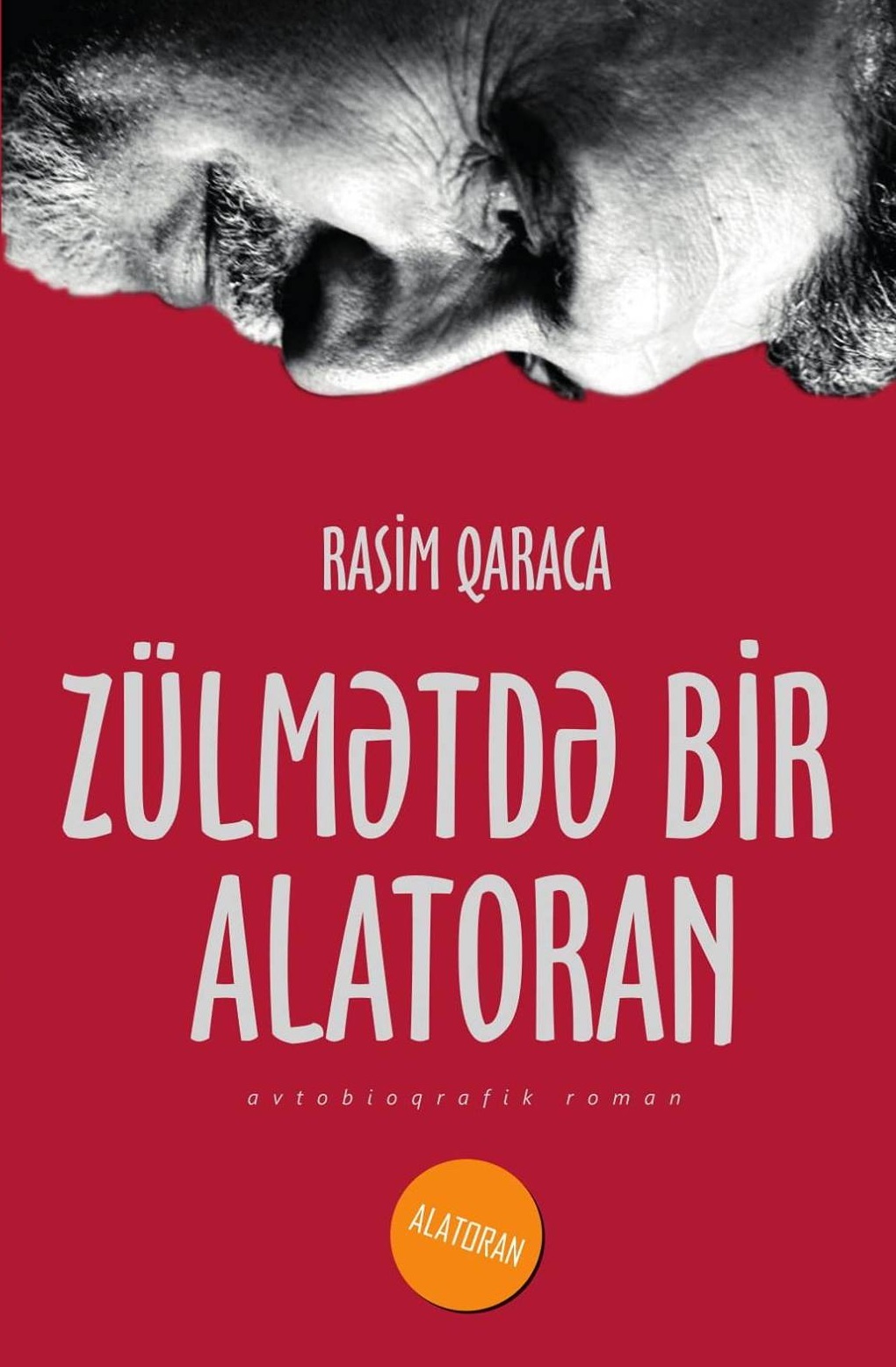
Among contemporary Azerbaijani poems, the one that has affected me most—and that I would likely call my favorite—is Rasim Garadja's “Siz, ey ordakılar” (“You, Over There”). No one take offense: it is the best. Too bad this piece isn't about that poem, or I'd praise it to my heart's content. To be honest, I'm inclined to praise the book I do want to discuss as well, because despite its exasperating qualities, I liked it for certain reasons. Setting aside some petty annoyances, one could call it a good book.
A longtime publisher—who, in this very book, calls literature his “beloved”—has brought it out through his own press. The text, however, is so rough-hewn that anyone even mildly sensitive to prose will, I think, find it hard to read with ease. I'm not talking about grammar and punctuation errors; neither you nor I have that much time. The roughness lies in the overall sloppiness. Numbers are written as digits everywhere. Glance at any page and it looks like a ledger; beyond being visually graceless, this also violates the conventions of Azerbaijani. For example (all the instances I cite here are from the edition dated September 24, 2024): on page 15 the author writes “3 poems of mine” instead of three poems of mine, “a print run of 150.000“ instead of a print run of one hundred fifty thousand, and “20 years later“ instead of twenty years later. A few lines down, “3 poems of mine” is repeated twice. At first I wondered if this was a stylistic choice (even so, it would be a pointless one), but the inconsistency—“150.000” later becoming “150 hundred,” “17 hundred” turning into “17.000”—makes it clear it isn't style at all. The author simply hurried to finish and didn't work the text with the care befitting his own writing, let alone his readers and long experience.
Nor does the sloppiness end there. After those accountant-like digits weary readers who came, as the cover promises, for an “autobiographical novel,” Turkishisms latch onto us. I don't know how to say this without offending anyone; in truth, I cringed as I read and felt embarrassed. And yet I want to put it in a way that won't upset an author older and more experienced than I am. Had he not personally inscribed the book to me, I would not have believed, on the basis of this text, that Rasim Garadja wrote it; even seeing his name on the cover wouldn't have persuaded me—I still have doubts. A writer who has devoted nearly his entire career to criticizing his predecessors, who for years published column upon column on the poor quality of Soviet prose, cannot—should not—use Azerbaijani at so low a level. In Zülmətdə alatoran (Twilight in Darkness) it is so bad that I almost urge you to read it for yourselves; I can't bring myself to reproduce quite so much mangled language here.
The author writes madəm instead of madam (“Given that” – left in the original; translator's note), alışmaq instead of öyrəşmək (“to get used to” – left in the original; translator's note), açıdan instead of bucaqdan (“from the angle” – left in the original; translator's note), nömrəni aramaq instead of zəng etmək (“to call a number” – left in the original; translator's note), hava atmaq instead of lovğalanmaq (“to boast” – left in the original; translator's note)—and so on, endlessly. The problem isn't merely the presence of Turkish words; it's that they're deployed at a level one associates with teenagers mimicking TV serials. Even the sentence structures aren't Azerbaijani: yazmış olduğum for yazdığım (“what I wrote” – left in the original; translator's note), görmüş olduğum for gördüyüm (“what I saw” – left in the original; translator's note), xarakterə sahiblənmişdi (“had owned a character” – left in the original; translator's note), bağımlısına çevrilirsən (“you turn into an addict” – left in the original; translator's note), ilk başlarda (“at the very beginnings” – left in the original; translator's note). The book is full of such grating calques. Toward the end the problem eases somewhat—the author “pulls himself together,” as he might put it—but the damage is done.
Speaking of the “novel”: the cover calls it an “autobiographical novel,” but it has nothing to do with the novel as a form. Autobiographical it may be; a novel is something else. Here the author recounts what happened to him personally, against the backdrop of the collapse of the Soviet Union and the subsequent state of Azerbaijani literature and its writers. We see everything from Rasim Garadja's private window. You might say, so what—that can still be a novel, provided there is an aesthetic approach, a distinctive style, a plotline, and an exploration of the central problem (the artistic question) from multiple angles. But there isn't. A pity. There are only incidents from the author's life—many of which have nothing whatsoever to do with the stated subject, i.e., post-Soviet Azerbaijani literature. At best, they give us a sense of how the author's worldview was formed. But what has that to do with us? Why should I be interested in how Rasim Garadja's worldview was formed? Let's grant that I might be; fine, let that pass. In a novel, everyone named becomes the author's character. Now let's look deeper and read the text more closely. At the beginning, Rasim Garadja (the “protagonist” of the “novel”) is a young man who dreams of becoming a writer and seeing his poems printed in a newspaper. He recounts what he went through on that path and tries to explain how he came to harbor so much rancor. From first page to last, everyone mentioned is a figure within Rasim Garadja's text-world, and thus, as the author's characters, ought to be treated without favoritism; each should be granted empathy and the right to speak. In Twilight in Darkness, the opposite occurs. We don't read the perspective of the character Rasim Garadja so much as the biased posture of the author Rasim Garadja. As for the other figures, what we get is ridicule, insult, pique, and hatred. That, to my mind, disqualifies the text from being a novel. Many of the accusations, moreover, are baseless and unexplained; the author does not substantiate his claims. As in Kamal Abdulla's Laocoön, Laocoön…, where everyone but the character Vaqif turns out to be “unscrupulous scoundrels,” here, too—with a few exceptions—everyone but Rasim Garadja is… well, that.
Which reminds me—slang. The author is inconsistent here as well: sometimes he masks slang with ellipses, sometimes he spells it out. Dear author, either don't use slang at all, or use it consistently. There is no ban on slang in a novel; slang is part of language, and it would be wrong to pretend it doesn't exist. But there must be a decorum to how it appears. A real writer, when choosing words—not only slang words, but even simple verbs like “to eat,” “to drink,” “to speak,” “to laugh”—is meticulous, seeking out the most fitting, most beautiful word that conveys the intended meaning most fully. If, at that moment, the most precise word happens to be slang, the writer uses it without a second thought—and it doesn't read like mere profanity. But if the author throws in slang whenever it occurs to him, venting his animus by having a character curse and insult, that becomes… well, that.
On the subject of words used properly, I want to touch on “qlamur” (“glamour”). The author uses it pejoratively, as if it were something ugly. In fact, the word entered our language from English, and into English from Scots. Its older forms are gramarye or gramarie. It carried meanings like “radiant,” “magical,” “alluring” and is related to the word grammar. Grammar, as you know, comes from gramma—“to write.” In the Middle Ages (the word is thought to have entered English in the 1700s), knowing grammar—being educated—was likened to wizardry; such people were radiant and compelling. Hence those who “shone,” who wielded the magic of letters, were called gramarye—that is, those who could write, or who emanated light. Over time the form shifted to the modern glamour, and the sense of “one who can write” fell away; what remained was the sense of brightness, radiance, clarity, intellectual sheen. In other words, a “glamour” person is not a faceless cipher, as Rasim Garadja suggests, but someone luminous, magnetic—indeed, if we go a bit deeper, someone learned in writing.
There is a passage in the book I cannot excuse under any pretext and must unequivocally call very bad: the author justifies his friend's suicide—casting self-destruction as a way of adding value to oneself. I won't belabor it here; there is ample research on this subject, and I myself have an essay titled “The Role of the Media in Suicide.” This is categorically unacceptable. Suicide must never be dressed up or granted exoneration. I cannot fathom how a writer of many years could make such an error. It should not have happened. A great pity.
The editorial credit lists Həmid Piriyev, but the text doesn't read as edited at all. No offense meant, but it's a very slovenly manuscript—neglected, ownerless, like an orphaned child. As I read, I wanted to raise my hands to the sky and cry out: “You, Over There—this book is called Zülmətə alatoran, it has 273 pages, 27,300 grammatical errors, and an incalculable number of sloppy sentences—come quickly; it needs editing, care, and respect for the reader!” Do read the original poem “Siz, ey ordakılar”; it is truly beautiful—a poem in the fullest sense.
Speaking of poetry, the sections on poetry and the vocation of the poet pleased me greatly; they went down like balm. More broadly, the book treats perseverance and the spirit of struggle quite well. Each chapter opens with one or more sentence-long poems, and these, too, are lovely. For example: “My father died; I found myself one on one with death.” Or another: “A human made of flesh, bone, blood—and songs.”
There are many other “minor” flaws—verb tense slips within a single sentence, subjects detached from predicates, and so on—but I won't go on. Let me say something of the book's strengths. First, that such a book exists is excellent; for us—especially for those who don't remember the Soviet era, or never saw it—it is a valuable source. The author records what he saw and shows the tricks writers resorted to in those years. One sentence I loved: “At that time, talking from the throat up was a virtue—and who could do that better than poets?” Rasim Garadja explains the vacuum in the literature of the 1990s; as you read and become acquainted with the processes of the time, things come into focus. The passages on the Azerbaijan Writers' Union (later the Azerbaijan Writers' Association) are very interesting; yes, some parts reflect the author's own views, but much is presented with facts. Reading these sections, I found myself pitying, once again, those among today's youth who fancy themselves writers yet still choose to toady to others.
In short: the book's purpose, its poems, the messages it carries, the perseverance and struggle it promotes, the character and sense of self it upholds—all of this suited me very well. I don't regret reading it; with a fine editorial overhaul it could be turned into a solid work.
In closing, I thank Rasim Garadja once more for the book. I hope that in subsequent editions the “petty” errors will be removed. And to you, dear readers, I strongly recommend the poem “Siz, ey ordakılar.” Thank you.