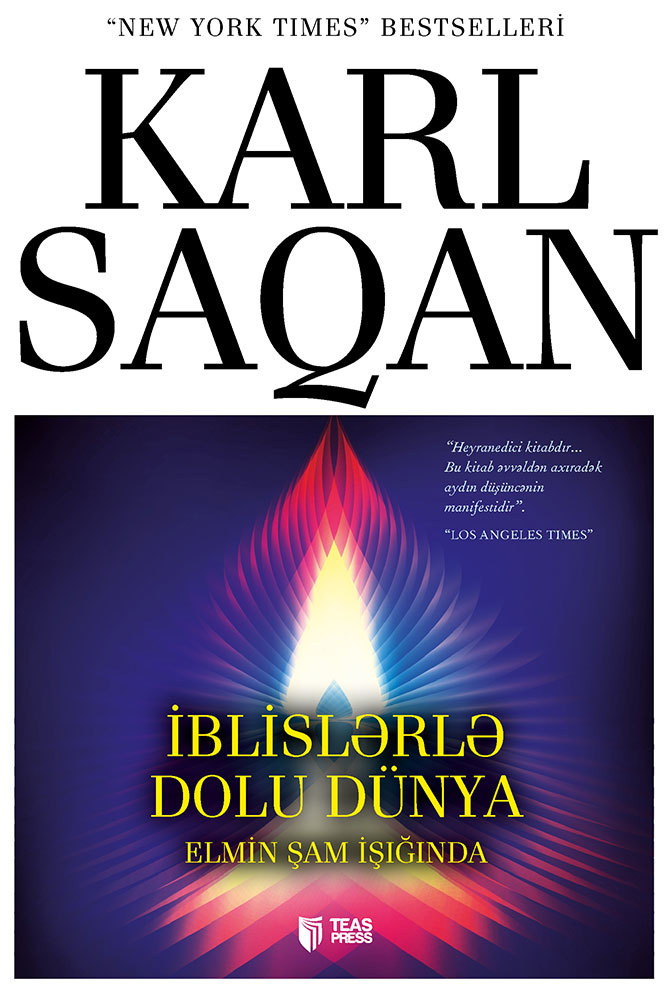
Carl Sagan – The Demon-Haunted World: Science as a Candle in the Dark
Translated by Yalchyn Islamzade
They said it appeared on the roofs of tall houses, or sometimes far away, shining a light while standing still in the dark sky. They came most often during Muharram, I think, right on Ashura itself. Back then, the word “aliens” was unfamiliar to us; “spacemen” hadn't taken hold, but “flying saucers” had been forced into our language, and that's what we called them. I myself once saw one gliding across the sky, emitting light, and then suddenly vanishing. I was terrified.
Carl Sagan's “The Demon-Haunted World: Science as a Candle in the Dark” has been translated into our language. The translation is by Yalchyn Islamzade, but after reading just a little, you are forced to settle on one of two possibilities: either Carl Sagan learned our language and wrote this book directly in Azerbaijani, or Mr. Islamzade read the book, understood it, set it aside, and then produced an entirely new, equivalent work. Because a translated book simply cannot be this fluid, this clear, and this perfectly attuned to the second language. I am not exaggerating in the slightest—the translation is, in a single word, magnificent. It seems that because the translator himself has a scientific background, he has perfectly captured the author's “tone of voice.”
My childhood fell at a time where, although I saw the Soviet period, I don't remember it. But the first years of independence struck such a place in my memory that much of it remains, even if I wished to forget. An era dawned, as if some angel had descended upon the village and, each day, “bestowed a gift” upon someone in their sleep. These “gifted” people multiplied like autumn mushrooms. The number of fortune-tellers perhaps exceeded the number of clients. Among these “gifted” ones, there were those who committed suicide, and those who died mysteriously at a young age. Some emerged victorious from this natural selection, progressing to specialized, world-class divination. Many others, however, turned back halfway.
Bizarre things often happened in the village. For example, at night, “ghouls” and “night-witches” would roam the cemetery. I never knew on what basis those who named them differentiated between them. I still don't know. Especially and for some reason, during the month of Muharram, the miracles were endless. Small shrines would be set up, and religious standards, decorated with black and red fabrics, would be placed in a large basin. Witnesses would swear that when the elegies were recited, the standard would rise and fall on its own, making it essential to toss offerings into the basin and pray. The larger, pole-bearing standards, meanwhile, would dash sinners to the ground in the passion play arenas while treating the faithful gently. You could hear these stories from many different people, many times over; it seemed impossible that so many people could be telling the same lie at the same time.
The book primarily serves to popularize science. It presents coherent arguments against pseudoscience and superstitions. One of the book's greatest strengths is its approach to issues without any bias whatsoever. Any pseudoscientific claim is discussed from several angles. The author almost never displays his personal position. He simply analyzes the experiments and scientific analyses conducted in the field, and this impartiality turns the book into an exceptionally pure work. As a result, we learn not the opinions of one scientist, but the scientific approach as a whole.
My late grandmother could “draw out the fright.” I learned much later that this “fright” was a “spirit.” Although she wasn't famous in this field, she occasionally had “commissions.” Usually, the elderly women of the village would come to her, name the afflicted person and their mother, and plead for help. My grandmother would toss a spoon or something into the middle of the room, whisper things under her breath, and, it was said, the person's “fright” would be drawn out. My grandfather was a former Soviet soldier, he had achievements from the Second World War he spoke of with pride, and he had many medals and orders; he never paid any mind to my grandmother's activities. One day, our physics teacher—“dreadfully knowledgeable, though not strong on pedagogy”—called and asked my grandmother to “draw out the fright” for someone... and this astonished me terribly.
I don't want to give any “spoilers,” as they say, by quoting sections or examples from this immensely enjoyable book. I can't bring myself to do it. It is such a meaningful, such a substantive book that you absolutely must read it for yourselves, to experience that pleasure firsthand. You will feel proud that such books can exist in our Mother Tongue.
There was a woman who was a man's second wife. After this matter came to light, the man had to bring that woman into his home as well. He was the first polygamous man I knew. Although our religion permits this, our local custom does not look kindly on it. A very short time after two wives settled into one house, strange things began to happen. The second wife (I never saw it, this is what was said) began to develop welts and bruises on her back, shoulders, and legs—entirely on their own. She would go to sleep at night and wake up to find long, striped wounds on her body, as if someone had beaten her with a thin switch. The word was that “a gift was being given.” Apparently, the “gift-givers” were trying to bestow something upon the second wife. This continued for a while; they tried, but it didn't work, they couldn't “give” it. The man built another house for the second wife. Most likely, the “gift-givers” couldn't find the new address, and the woman was saved.
Apparently, there are millions of people in America who claim to have been abducted by aliens. Would so many people lie? Or is an entire society experiencing the same hallucination? The book is filled with countless questions that plant a thorn in the heart, and answers that remove it. It speaks of the importance of asking questions, of asking the right questions. In many places, it touches on children asking questions; in general, the book has very interesting advice on child-rearing. The author also touches on how parents should interact with children and how to handle their difficult questions. In many parts of this book, which begins under the banner of popularizing science, we are even given valuable information about getting rich and earning money—information not found in personal development or motivation books.
The most amusing of the “night-witch” incidents I mentioned above was the very last one. There used to be a custom. After someone died, a tent was set up over their grave, and at night, a mullah would come and sit, reading the Quran for hours. This, if I'm not mistaken, was called “entrusting the Quran.” One night, a rumor began to spread that our village, too, had a “night-witch.” It would appear and disappear among the graves at night. Of course, we were children and we were scared. Nowadays, whenever I happen to be in the village, I make a point to visit the cemetery at night; you should try it, it's immensely pleasant, it's silent, and you clearly understand how very dead the deceased are. No matter how long you wait, the “night-witch” no longer comes. Anyway... That tradition of “entrusting the Quran” at the graveside was abolished in one night. Because the “night-witch” had come, shaken the tent, and made strange noises. At that moment, the mullah—holding the book of God, the creator of absolutely all creatures in the universe (including night-witches)—fled the cemetery in such a way that he probably hasn't dared to return even now. This is a somewhat amusing story because I know that “night-witch.” I know that he would occasionally appear while gathering grass for his cow in the cemetery at night, and that he later shook the tent to scare the mullah. The “night-witch” doesn't come anymore, because he works as a laborer in Baku.
In his book, Carl Sagan speaks with heartache about the collapse of the American education system. He emphasizes its clear consequences. He compares the attitude of America's founders toward science at the time of its creation with the situation at the time the book was written, and he shows where education, science, and a scientific approach can take a country. He shows how the scientific method is effective not only in laboratories but also in our daily lives for combating ignorance. He teaches us to measure the degree to which any idea presented to us corresponds to reality. He clearly explains the ways to distinguish science from pseudoscience.
As we grew up, we learned that most of the things we feared were, in fact, born of ignorance.
When you read this book, you become convinced that knowing is never frightening; on the contrary, reality is mysterious and miraculous. Usually, we are indoctrinated with the opposite. Miraculous things are pushed on us as things whose true nature we do not know. And yet, as we learn about the cosmos, nature, and ourselves, are we not more astonished, more inspired? For example, isn't it a pleasure to learn that inside a cell, which looks smaller than a fingernail even when magnified forty thousand times under a microscope, more than a hundred biochemical processes—many of which still cannot be simulated in a laboratory setting—are happening simultaneously, and that they never interfere with one another? When reading the book, you understand well what doors our ignorance opens for charlatans. You see clearly that the truly scary things are not the aliens, “ghouls,” “frights,” or “night-witches” for whose existence no proof can be found. The truly scary thing is not knowing the way out from the countless problems whose existence is beyond doubt. The book proves that one must always be afraid of not knowing; abandoning this fear unequivocally leads us over a cliff, dragging us into slavery.
I have never witnessed scientific books being distributed for free. Nor have I heard of students being provided with high-level conditions in fully renovated homes simply so they can study well and become useful cadres for society, without any proselytizing. On the contrary, tuition fees rise year after year, in inverse proportion to the quality of the (non)education at higher education institutions. Instead, rotten literature that tries to “refute” the theory of evolution—a topic long settled in normal scientific circles—is distributed for free, despite its glossy packaging. Do we really need this more than we need science? The book also discusses why and how such pseudoscientific sources multiply, as well as who is to blame for them.
The author complains bitterly about the literacy rates of the American population and speaks of its dire consequences. I thought at this point that we are a happy nation in this regard. Can you imagine, Azerbaijanis are in second place in the world in this matter? If I'm not mistaken (I could be wrong), we are only behind Canada. This means that the literacy rate of us Azerbaijanis is higher than all developed European countries, America, and Japan. It also means that while almost all of us know how to read and write, while we all possess this blessing, we are also world leaders in avoiding reading. The reasons for this can also be seen in this book. Furthermore, the work touches on issues that resonate well with our own current situation. It shows the reason for the proliferation of our ever-increasing “why?” questions and presents a way out. As I said, I don't want to spoil it by writing too much. This book absolutely, absolutely must be read!
As a child, I thought the oddities I spoke of above only happened in the village. It turns out, the biggest superstition was the one being most promoted. It turns out, the day would come when night-witches, ghouls, fortune-tellers, and charlatans would appear on television channels. It turns out, as the education system collapses and the candle of science burns low, our world will be filled with demons.
The book “The Demon-Haunted World: Science as a Candle in the Dark“ lives up to its name with great success. It analyzes the parallel paths of superstition and science that humanity has walked in Europe, America, Japan, and other places, and you become thoroughly convinced that demons vanish only by the candle-light of science...
I express my deep gratitude to Mr. Yalchyn Islamzade, who wrote this magnificent book—which has no shortcoming save for the thinness of its cover—in our mother tongue, and I hope he continues to enlighten us.
Thank you!