Shadow: Code Name Umbra
Sudaba Sarvi
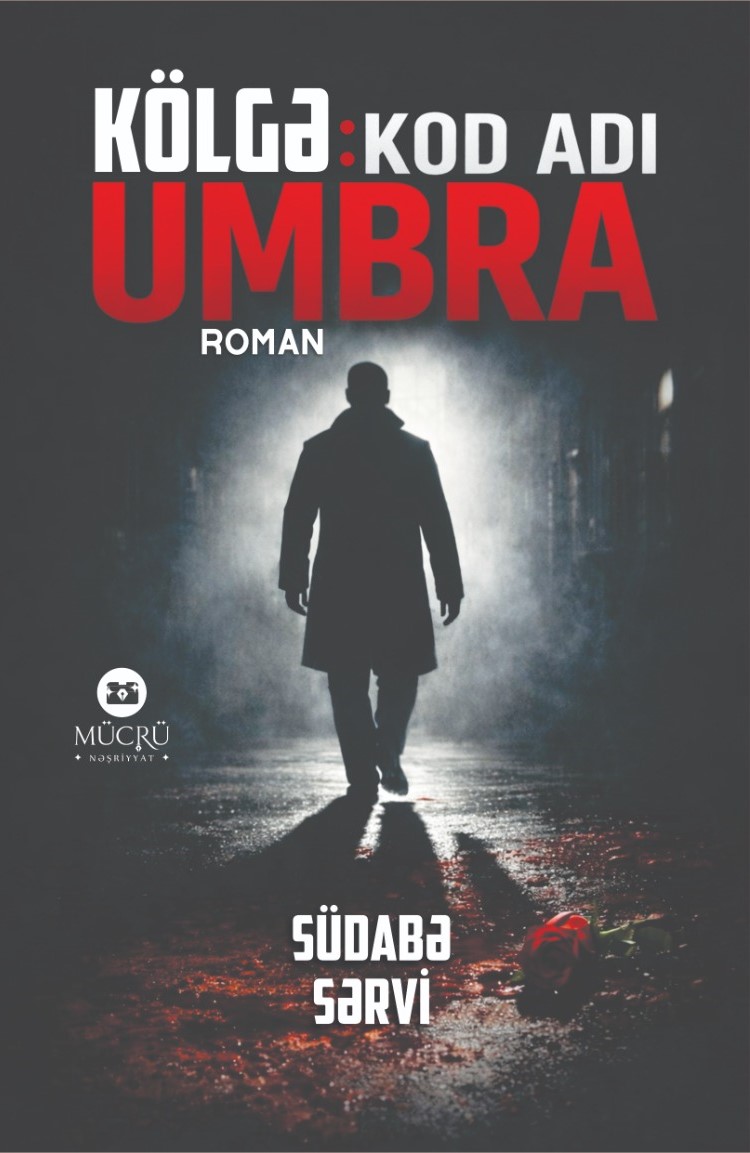
Before I talk about Sudaba Sarvi’s novel Shadow: Code Name Umbra, I want to say a few words about the book itself. The design and physical quality of this 2026 edition from Mujru Publishing House disappointed me. After the cover come the title, the publication details, a note saying the author wrote the book in tears, the “From the Editor” section and the foreword, one straight after another, without a single blank page to breathe.
You may ask what the physical quality of a book has to do with its literary value. I don’t see it that way. If we turn away from the glossy, short, funny, tearful videos of social media and choose to read a book, we should have a good time with that book. Publishers must make a book appealing as a physical object too. Just as writing is not merely blackening paper, reading is not merely seeing words.
Speaking of breath, the events in the novel itself never pause for breath. Drugs, crime, bribery – or the sermons offered in response to all of them. I have no objection to heavy subjects being gathered in one novel, but here one tragedy has barely had time to be lived before the explanation of the next begins. We learn more about what happens to people than about the people themselves.
One can sense that Sudaba Sarvi is on the side of goodness, that she grieves deeply for families torn apart by drugs, and she writes these passages in very tender notes. But the text tries to carry this feeling not with literary weight but with didactic advice. As a result, the book reads less like a novel than like the heartfelt notes of a lady journalist burning with concern for society. In several places it even says: “The author grieved as she wrote.” Instead of feeling the grief, we are handed a statement about it.
Sudaba Sarvi’s light humour, on the other hand, sometimes makes us smile. Of Bomba (‘Bomb’) Ramiz, who comes into the investigator’s office, we read: “You’d think it was a giant ball, walking.” His exit matches the description: “Bomba Ramiz yumrulanıb backwards out of the room, like a ball.” Yuvarlanıb (‘rolled’) would have suited better than yumrulanıb(‘curled into a ball’), but the man comes alive before your eyes. Or this sentence on page 78: “Along the railway, the fog lay spread in the air like thick silk.” I liked descriptions like these.
The flashbacks work too: they let us connect the characters’ present with what happened before. A number of interrogation scenes come across as natural and convincing. I particularly liked that the investigator Farid Bayramli is in no hurry to draw conclusions straight from the details. But the novel does not trust us to reach our own conclusion about its hero’s patience; it explains it to us again and again.
In fact, I have never seen a character praised as much as Farid. On page 21 we learn that he is “a highly educated, capable, attentive professional investigator who takes his work responsibly”. On page 58 he is again presented as an educated, intellectual, honest investigator who upholds the honour of his uniform. On page 138 we get a separate biography: year of birth, age, education and a good deal of praise. All of it in the author’s own narration. After so much introduction, you want to watch the man at work. The plot, however, does little to live up to the praise.
On page 100, Farid sits in his office, reaches for a button and gives an order: “Bring me a list of everyone who left the city that night. Air, land, sea. Doesn’t matter.” The night in question is the night of the novel’s main crime: 17 March 2010, described as the eve of Ilakhir Charshanba – the last of the festive Tuesday evenings before Novruz – although by the calendar it fell on a Wednesday. Instead of “Chief, come to your senses – nobody knows who comes in or goes out of Baku, where would I find such a list?”, the reply to this absurd order is: “Yes, chief!” A few hours later, the list is on the desk. Passenger lists for planes and ships one can somehow imagine. But where does a complete list come from of everyone who left the city by land on a holiday evening – mind you, not the country, the city (Baku)? Who recorded those who drove off in their own cars or got into someone else’s? The problem is not the lack of time; it is that the novel treats such a record as existing and never explains it. A phone that is called just once gets located, yet nobody even tries to locate Umbra, who sends Farid message after message. There are many such lapses – literary, logical and linguistic. That the novel was written without care is evident from its very first sentences. On top of that, this is the thirteenth book by an author who is a member of the Azerbaijan Writers’ Union; it was edited by Mushfig Khan, and its foreword was written by the People’s Writer Chingiz Abdullayev.
Details sometimes pour down on the novel like a cloudburst: a bloodstain is found, a button from another crime turns up, traces point to one person. How the investigation is carried out, however, remains unseen. Someone simply phones the investigator to say that a bloodstain has been found at the crime scene and that it is so-and-so’s blood (I won’t give the name, to avoid spoilers). Dear readers, and dear Ms Sarvi: the owner’s name is not written on a bloodstain. Blood does not announce, “I came from so-and-so.” To know whose it is, a DNA profile must first be obtained from the blood, and that profile must then be compared with others: either those in a database or samples taken from suspects. In the novel there is none of this: no sample is taken, no comparison is made, no result is awaited. The events take place in Baku in 2010, and the answer arrives with a phone call. The Hollywood cliché that “where there’s blood, the killer is known” is false in most cases; it calls for a little research before it goes into a novel. But what’s the use? Expecting an author who moves Ilakhir Charshanba to a Wednesday to sit down and read FBI guidance would be asking too much. Just in case, I am adding the FBI’s official explanation of the role of DNA in criminal investigations below.
The human stories are rushed to their conclusions in the same way. A girl named Arzu gets into university; she is bought “special clothes, phones” (yes, phones, plural), and her father hands her the keys to an expensive car. Then she meets Rana, they drink wine with Rana’s “boyfriend”, and a blackmail video emerges. To buy drugs, Rana forces her to steal money from home. Yet we never see the event the blackmail rests on. I would like to say “events develop rapidly”, but they do not develop; the novel hurries along and simply tells us what happened. Words instead of scenes, claims instead of description.
Then it turns out that Arzu, too, is on drugs. Her mother, a professor, and her father, a government official, choose as their way out to take her out of university and lock her in a room. When the girl goes into withdrawal – the severe crisis the body and mind go through when a drug is suddenly stopped – she bangs her head against the wall, screams, begs. They do not open the door. They simply do not. Once, her mother reaches for the latch, but does not draw it. In her inner monologue, the woman addresses herself by her academic title: “Stop, professor. What are you doing? Stop!” In such a harrowing scene, that form of address pulled me away from the girl’s pain and made me smirk at the oddness of the sentence. Then again, I thought, a mother who locks her drug-addicted medical student in a room instead of seeking professional treatment can only be called a professor by herself.
It is true that bright young people ruin their lives with drugs, and we want to see the echo of this painful reality in fiction too. Withdrawal, however, is not a test of willpower; it is a condition that requires medical supervision and can, in some cases, be life-threatening. Yet in this novel we never stand at the epicentre of the family earthquake; instead, we hurry past the very point where the love of an ignorant mother, who locks the door and calls from outside, “We want to save you, my darling girl,” collides with the author’s compassion. Just in case, I am also sharing an official link on managing withdrawal below.
Then there is Aghaali, who has sold everything because of his addiction – by his own account, down to his bed. The author first presents him as a famous athlete, then as the coaches’ favourite, then as a back-to-back, and later a three-time European champion. Fame went to his head, and he fell into drugs. He is questioned among the suspects, and the interrogation scene turns into a pulpit for moralizing. Before Aghaali even arrives at the station, the author gives him a thorough scolding: “do you ever stop to think?”, “you’ve wrecked your family”, “who have you fallen in with?” The interrogation then continues with Farid’s advice: “It’s a shame. There’s a little girl growing up in your home. Do you ever think about her future?” The man weeps and agrees. Now, you tell me: is this line strong enough to turn back an addict who has lost everything? We see nothing of the character’s inner readiness: the investigator speaks, the character agrees. As if no one had ever reminded him of his family, his children, until now. In short, we are told he received treatment. Six months later, the athlete returns to the same room in good health and is now introduced as a five-time European champion. Where the two extra titles came from is never explained. What is more, just two lines after “Farid recognized him by the scar on his face”, we read, to show that the champion has put flesh back on his bones: “even the scar on his face had disappeared.”
The novel’s rhythm is odd too: scenes either rush forward or get stuck on needless words. When Farid secretly enters the archive of his own department, we learn even what the key is made of: “a thin iron key”. Yet the result of his search for evidence against Teymur Talibov is dismissed in two sentences: “Farid’s efforts came to nothing. Once again the chief got a call from above.” Elsewhere we get a list: he goes home, goes into his study, makes “milky coffee” and drinks it sip by sip. Of a man said to be thinking long and hard, we learn more about his coffee than about his thoughts. And in this form: “The coffee seemed very delicious to him.”
And yet the clash with Teymur is a fine chance to get to know Farid. Sudaba Sarvi builds Teymur’s early dialogue and manner naturally and with colour: as he speaks, we see who he is. But his later storyline, too, bows to ready-made accusations. The main loss, however, lies elsewhere. Teymur Talibov is protected by his brother, a deputy minister. At some point the deputy minister is dismissed, and Teymur is left “headless”, without a patron. Farid, who until then could not raise his voice because of calls from above, exposes Talibov the moment that protection is gone. The head of the department tells Talibov he is being dismissed and adds: “The only help we can give you is that you won’t be arrested, but you must hand in your gun and your seal.” By this point in the novel, we already know Talibov’s vile crimes from the author’s didactic, hurried narration. On top of that, he framed a woman’s husband and had him arrested, then had sex with the woman, and she took her own life. All of this is thrown in his face right there, yet he is not arrested; he walks out of the prosecutor’s office a free man and goes home. And Farid – “an educated, intellectual, honest investigator who upholds the honour of his uniform”, as the author never tires of praising him – not only stays silent but is pleased and even laughs. Why does the impunity of a man whose crimes he could not stop for years not trouble his conscience more? In my view, had the novel dwelt on this, the paradox would have made a far more literary question than “Who is Umbra?”
Nor can I let pass the phrase Farid uses about that woman’s suicide: “you have cleansed your honour.” A character’s words are not automatically the author’s position. But here it is said by the hero the novel presents as a moral example, and that judgement is never questioned. As I noted in my piece “The Role of the Media in Suicide”, we must keep sensitive readers in mind and act responsibly on such matters. I utterly reject, and strongly condemn, presenting suicide as a way of cleansing one’s honour!
In the “From the Editor” section, my former publisher and friend Mushfig Khan writes: “The main strength of this novel does not lie solely in the question ‘Who is the killer?’” As I read, I kept looking for that other strength. The novel, however, kept me standing in front of the question “Who is the killer?” On page 236, the question even appears word for word.
Someone arrives; “O” – the Azerbaijani pronoun that does not reveal whether it means he or she – approaches, is seen in a cap, speaks behind a mask; the investigator phones somewhere and is told “At once!” The mystery is created by deliberately withholding details, and this, as always, makes it artificial. Just as Farid turns into a caricature through the author’s praise, the novel turns to plastic through the narrator’s withholding in the manner of “who was that?”, “who was this?”
Keeping secrets is a detective story’s right, but here the secret often arises not from the events themselves but from information being cut off: “And they told the investigator the secret they had been hiding. As it turned out…” Farid learns; we do not. On page 71, the questions “Who is the ‘O’ visiting Aysu’s grave? What did they feel guilty about?” are followed by the call: “Let us follow the course of events.” Oh, come on – let’s like and subscribe and hit the bell…
I had guessed Umbra’s identity by the middle of the book. Farid, too, meets Umbra and learns who it is, yet the hide-and-seek goes on. It’s as if you can see every part of the person hiding, but to keep the game going you pretend: “Oh noooo, where are you? I can’t find you!” That’s how we played hide-and-seek at home when my children were small.
Towards the end, I read with interest how a woman writer named Sarvi meets Farid and declares him the hero of her detective novel. I especially liked the metaphor of “a thin veil between reality and paper”. But the more I thought about what I had read, the more that veil took on another meaning. It is as if the writer herself sits in the veil between paper and reality and passes on to us only what she pleases. Important events are hidden, while what we are supposed to think about them is explained over and over again. The character Sarvi gives Farid her own book, The Shadow of Pain. The novel doesn’t say so, but this is Sudaba Sarvi’s own book, published by Mujru in 2023. Perhaps it doesn’t matter, but let me remind you: the events take place in 2010.
I don’t want to go into the details of the ending, because for a novel whose backbone is the question “Who is the killer?”, that wouldn’t be fair. But I will say that Farid Bayramli solves the crime. This is not a spoiler: the People’s Writer Chingiz Abdullayev says so in the foreword.
So. I liked Sudaba Sarvi’s sincerity, her light humour and her occasional fine descriptions. Taken as a whole, though, the text I read struck me as a crime-page article filled with sincere advice and tender moralizing.
Links: