On the Brink
Javid Ramazanov
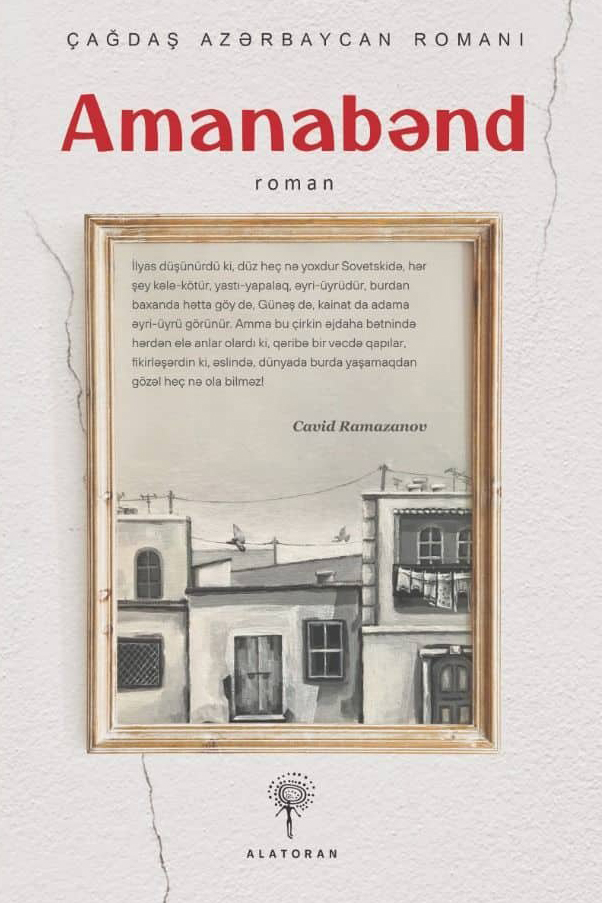
On the Brink is Javid Ramazanov’s debut novel. I hope this turns out to be the author’s weakest book. The novel does try some interesting tactics and novelties. The narration is refreshingly free of bombast; the inner contradictions of the main character (Ilyas) are sketched with interest; and when he mutters to himself—scolding himself or grumbling about others—he feels sincere. These were the parts I liked. Most importantly, the author eschews peacocking; he tells the story in a plain, lucid manner. That, to me, is a virtue. Still, there were many things in the book that simply didn’t sit right with me. Far too many…
The subject can be summarized briefly—indeed, it can hardly be discussed at length. A boy named Ilyas, living in Sovetski (not translated, translator’s note), falls for the girl next door while in tenth grade; that’s about it. Ilyas falls for Shahla, thinks about her all day, the word reaches the girl, she invites Ilyas over, they kiss, and that’s that. Ilyas doesn’t forget the girl; the girl forgets Ilyas… I was cringing as I wrote this. I don’t know how Mr. Javid managed to put himself through so much effort to write this novel.
You might pick up the book—guided by the jacket copy and the cover image—and expect a full-bodied novel about the demolition of Sovetski and, against that backdrop, human fates: heavy drama with pronounced philosophical, psychological, social currents. In a word, a packed novel. No. Although the name Sovetski appears a few times, what we get—the episodes the author recounts—are ordinary, generic, simple stories that could take place in virtually any Baku neighborhood. This is not a novel about Sovetski; it merely carries the name, not the spirit.
The writer Parviz Jabrayil is listed as the book’s editor, but I don’t think that’s quite right—the book does not read as edited. No proofreader is credited, and I suspect there wasn’t one; it shows. The text layout in general is in very poor shape. In an edited and proofread book, what are phrases like “olips paçkası” (an Olips pack—not translated, translator’s note), “fiqura” (not translated, translator’s note), “to touch the ceiling 250 times” (written in numerals), or sentences like “The New Year holiday had ended; days were passing since classes began” doing here? And these are all in the author’s narration—so we can’t pin them on characters in dialogue.
So… In my view there isn’t much here worth lingering over. This is one of those novels I won’t be recommending and will try to forget. I value the author’s innovations and the techniques he experiments with, but they don’t save the novel, alas. For all the effort, On the Brink ends up, as a whole, a work with no essential weight for me. I hope Mr. Javid will delight us with finer novels in the future.