Sound or Red
Shamkhal Hasanov
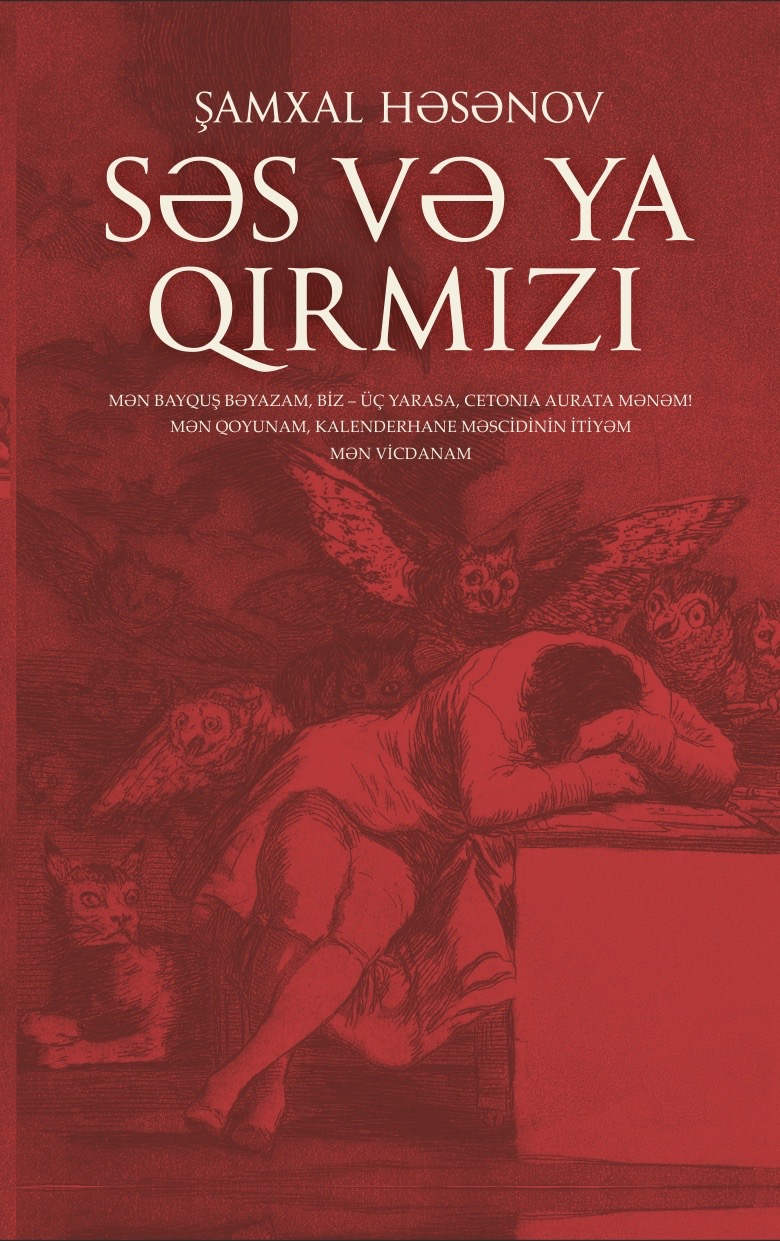
Reading this novel requires a specific taste, and it provides a specific pleasure. In general, this is Shamkhal's style. From the very first sentences, you want to rush through the novel, to leap over the sentences, anxious to see “what happens next.” However, the eloquent and professional writing style doesn't allow it; it's as if it grabs you by the arm and holds you back, saying, “Where are you rushing? Calm down, sit down, you are reading a work of literature here.” I'll give my conclusion at the outset: I loved it! Bravo! I will always remember the time I spent with “Sound or Red” with great fondness.
I have read everything written about this book, and no one discusses the novel itself; everyone gets “stuck” on Shamkhal's sentences, some in a good way, some in a bad. Therefore, I want to talk a little about the novel itself.
Contrary to what is said everywhere about this work, the narrative is not written in the style of an internal monologue or the stream of consciousness technique. One might partially agree with “internal monologue,” but it is definitely not stream of consciousness. Firstly, no one's consciousness flows so artistically and ornately; secondly, this is refuted within the novel itself. I won't dwell on this, so as not to spoil the plot and kill the reader's interest; you will see when you read it.
The situation in the novel is this: It is the eve of the Eid al-Adha, and the mother, Sama, invites a friend she hasn't seen in twenty years, along with her daughter (Maryam), to her home in order to “couple up” (I couldn't find a better word) her twenty-three-year-old son, Idris, with Maryam, who is described as hyper-super beautiful. The father of the house, Ramiz, has been lying in a hospital for many years (eight, or ten?) with a spinal cord paralysis, acquired in some unknown way. Truly, as a doctor myself, I don't know which hospital keeps a patient with such an illness in a ward for that many years without sending them home, but (according to the author) this is not a crucial detail. The author's voice—or rather, Shamkhal's—is never heard in the work. There are no phrases like “so-and-so did this, or said that.” Everything is delivered in the first-person singular—from the perspectives of the mother Sama, the son Idris, and the father Ramiz. There is another character in the novel: books. They appear to Sama as evil forces that once made Ramiz, and now her son Idris, unhappy. However, we do not read monologues from their perspective.
Let's return to the plot. The guests arrive. Idris falls head over heels for Maryam, but Sama falls for her even harder. Since Idris is a flighty boy who reads books all day, he talks with Maryam about books for a few minutes. After the guests leave, the mother and son visit the father in the hospital and deliver this “glad tidings” to Ramiz, who meets the news with what can only be described as skepticism. The next day, it seems, Idris and his uncle go to buy the sacrificial meat. Her twenty-three-year-old son Idris, whom Sama—burning with the desire to have a grandchild—is trying to marry off, is unable to watch the sheep being slaughtered and is afraid of seeing blood, so he wanders off to sit in a side-street and daydream. A little later, they take the meat and go to Sama's sister's house, where it becomes clear that the plan to “couple up” Maryam and Idris was not only his mother's idea, but also his aunt's. Then, the mother somehow convinces the “child” to take a Salman Rushdie book to Maryam, claiming “the girl asked for it herself.” Idris, for some reason, is then faced with a choice between meeting Maryam and writing a novel. And... you can read the ending for yourselves. That's it. This is the plotline of the novel. However, this plot root, which spans only three days, has such branches, such leaves, and such fruits that... well, you just have to see it. The mastery in Shamkhal's pen, the delicate, soft, and yet harsh harmony he strikes, truly fascinates. Bravo!
Here, for some reason, Idris's getting closer to Maryam is placed in polar opposition to his writing a novel, as if he must either “befriend” Maryam or write a novel. I don't know; I think instead of fictionalizing this conflict, he could have written more fulfilling texts after befriending Maryam. No?
Shamkhal depicts the inner worlds of these three characters feeling by feeling, and the novel progresses thought by thought, not event by event. The colorful depiction of feelings, senses, and thoughts is beautifully rendered!
Ramiz, who has been in the hospital for years, turns out to have wanted to be a writer in his youth. He read and wrote all day, but somehow, he was never able to write a novel. During his time in the hospital, he writes down the voices in his head and collects them in a box under his bed. Those writings are wonderful. Reading the sections “We Three Bats,” “I Am a White Owl,” “I Am a Sheep,” etc., is quite enjoyable, delicious, and heartwarming. True, in these parts, the author sometimes delves into technical-biological information while speaking in the voice of the owl or the bat, and this breaks the literary aesthetic of the text. But, if we remove those, these sections add a special beauty, sound, and color to the novel. Ramiz also writes about a woman named Z (Zeybe), whom he loved before marrying Sama, met with after marrying, and made love to after Idris was born. In these writings, the word “betrayal” is not very popular, because Ramiz doesn't think he is betraying anyone, and he depicts this dual love color by color, passion by passion, love by love. Here, too, the author sometimes goes into too much detail; in my opinion, there was no need to go so deep in the lovemaking scenes between Ramiz and Z. You will understand when you read it. In these sections, Shamkhal takes us sometimes to the distant past, sometimes to the recent past, and sometimes returns us to the present, without ever explicitly signaling it. I think this was excellently done. Beyond this, the events progress through monologues; meaning, there are no clarifications like “we got up and went to X place, then Y happened.” You must follow the plot through the monologues. This keeps the reader alive and encourages them to be alert.
For attentive readers, there is a section titled “I am Cetonia Aurata,” which, in my opinion, can be considered the most successful, or, as they say, the most balanced part of the novel, because truly, everything balanced out for me there.
The novel contains many expressions whose arrival in our language was not at all beautiful, such as “şezlonq” (T/N: from the Turkish/French 'chaise longue'), “şəmsiyyə” (T/N: from the Turkish 'şemsiye' for umbrella), and “gəlişigözəl” (T/N: a Turkish calque meaning 'random' or 'haphazard'). The person delivering the monologue, on the one hand, emphasizes their desire to speak the language correctly, using “zəncirbənd” (T/N: a native Azerbaijani term for 'zipper') instead of “zamok” (T/N: a Russian loanword for 'lock' or 'zipper') (and even smiles at this), and finds beautiful words like “xoşnud” (T/N: a Persian-derived word for 'pleased') as alternatives to “xoşbəxt,” “sevincli,” or “şən” (happy, joyful, cheerful); but on the other hand, they spoil the text with words like “peç” (T/N: from the Russian 'печь' for stove), “duxovka” (T/N: from the Russian 'духовка' for oven), “kabluk” (T/N: from the Russian 'каблук' for heel), and “lüstur” (T/N: from the Russian 'люстра' for chandelier). Furthermore, the names of foreign authors are not given as Jan Pol Sartr, Qarsia Markes, or Salman Rüşdi (T/N: the standard phonetic Azerbaijani spellings), but rather as “Jean Paul Sartre,” “Garcia Marquez,” and “Salman Rushdie.” It is possible to debate the correctness of writing names this way in our language from many aspects, but according to the “Law on Language,” foreign names must be written in our language as they are read (phonetically). I think Shamkhal, who is a lawyer by profession, should have approached this issue, at the very least, with more respect for the law. In any case, the “Qanun(!) Publishing House” (T/N: 'Qanun' means 'Law') and the book's editor, the esteemed writer Sherif bey Aghayar, should also have been attentive to this matter. I won't lie: as someone sensitive to language, these things irritated me, pulled me out of the text, and sometimes made me cringe (T/N: the idiom 'ətimi tökürdü' literally means 'it made my flesh fall off').
If we disregard the minor errors, the text reads quite fluently and “deliciously.” It flows beautifully, especially when read to the sound of soft piano, making one feel particularly “xoşnud” (pleased). One could talk at length about Shamkhal Hasanov's “Sound or Red.” In conclusion, I want to note that IN MY OPINION, this book succeeds as a text, but is average as a novel.